
How to Advertise Your Coworking Space or Serviced Office Without Paying Broker Commission
How to Advertise Your Coworking Space or Serviced Office Without Paying Broker Commission
If you operate a coworking space, serviced office centre, managed office or flexible workspace venue, attracting new customers is essential to maintaining occupancy and growing your business.
But where should you advertise your coworking space or serviced offices to generate enquiries without paying substantial broker commissions?
Traditionally, many flexible workspace operators have relied on commercial property agents and specialist office brokers to introduce prospective occupiers.
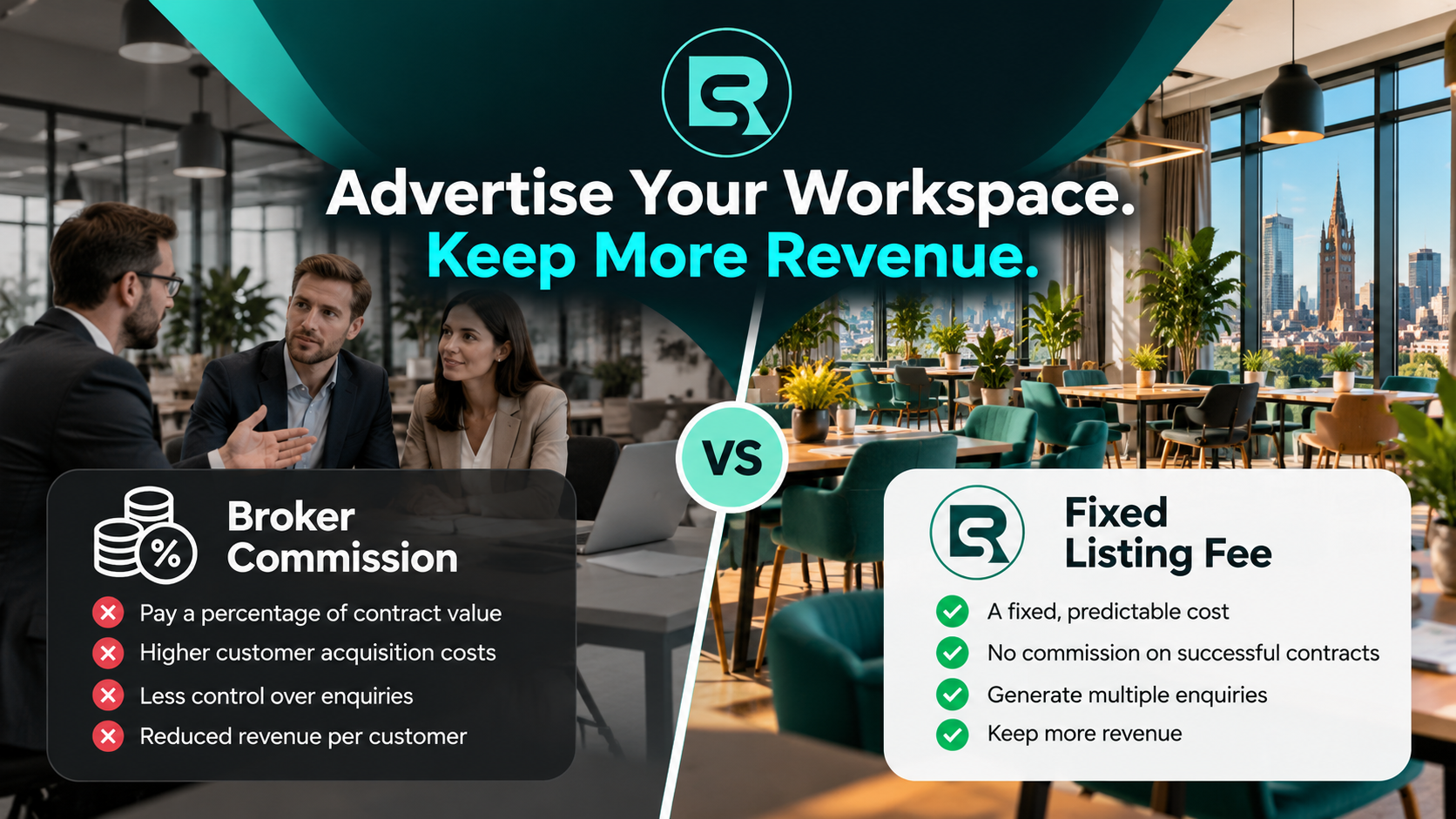
While these intermediaries can provide valuable enquiries and help fill vacant offices, successful introductions may involve commission calculated as a percentage of the contract value.
For workspace operators, particularly those offering longer licence agreements or larger private offices, these commissions can represent a significant customer acquisition cost.
An alternative is to advertise your workspace through an independent directory that charges a fixed listing fee rather than commission on completed transactions.
In this guide, we explore the different ways to market your flexible workspace, the advantages and disadvantages of commission-based brokerage, and why fixed-fee advertising can offer operators greater control over their marketing expenditure.
1. Where Can I Advertise My Coworking Space or Serviced Offices?
There are several ways to promote coworking spaces, serviced offices and other flexible workspace facilities.
The most effective marketing strategy will often combine multiple channels rather than relying on a single source of enquiries.
Your Own Website
Your website should be one of your most important marketing assets.
A well-designed website can provide information about available offices, coworking memberships, meeting rooms, facilities, pricing and location.
Search engine optimisation (SEO) can help your website appear when prospective customers search for workspace in your area.
However, achieving strong organic rankings can take time, particularly in competitive cities where established operators, brokers and directories already occupy prominent positions.
Google Business Profile
A Google Business Profile can help potential customers discover your workspace through Google Search and Maps.
For operators with physical locations, an accurate business profile containing photographs, opening hours, contact information and customer reviews can be particularly valuable.
Maintaining your profile and encouraging genuine customer feedback can support your local online visibility.
Social Media
LinkedIn, Facebook and Instagram can provide opportunities to showcase your workspace, promote available offices and share information about your facilities.
Social media can also help build awareness among local businesses and professional communities.
However, organic social media activity does not always reach people who are actively searching for office accommodation.
Commercial Property Agents and Office Brokers
Office brokers can introduce prospective occupiers and may assist with requirements gathering, arranging viewings and negotiations.
Some brokers have established relationships with corporate customers and businesses seeking multiple offices.
However, commission payments can substantially increase the cost of acquiring a new customer.
Flexible Workspace Directories
A specialist flexible workspace directory allows operators to advertise their venues alongside other workspace providers.
Potential customers can search by location, workspace type and other requirements.
For operators, a directory can provide an additional route to market without having to rely exclusively on their own website or commission-based intermediaries.
The commercial model matters: some directories operate on commission, while others charge fixed advertising or listing fees.
2. How Much Commission Do Serviced Office Brokers Charge?
Broker commission arrangements vary depending on the market, operator, agreement and services provided.
Some arrangements involve a percentage of the total contract value, while others use a percentage of annual licence fees, a fixed fee or another agreed calculation.
For example, a broker might charge a commission equivalent to 10% of the first year's contract value.
This is an illustrative example rather than a universal industry rate.
For a small coworking membership, the resulting fee may be relatively modest.
However, for larger serviced offices or managed workspace agreements, the commission can become substantial.
Example: Commission on a Serviced Office Agreement
Consider a business taking a private office at £4,000 per month on a 12-month agreement.
Total first-year contract value:
£4,000 × 12 = £48,000
At an illustrative commission rate of 10%, the operator would pay:
£4,800 in broker commission.
If the same customer renewed or expanded, additional commission might also apply, depending on the broker agreement.
This is an important consideration when calculating the profitability of a new customer.
The operator may have incurred other costs, including sales staff, marketing, fit-out, incentives and the cost of providing services.
Broker commission adds another expense to that acquisition process.
3. Why Fixed-Fee Workspace Advertising Can Be More Cost-Effective
One alternative to commission-based brokerage is to advertise through a directory charging a fixed listing fee.
Under this model, the operator pays an agreed amount to advertise its venue for a defined period.
The directory does not take a percentage of the value of each successful transaction.
This can provide several commercial advantages.
Predictable Marketing Costs
A fixed listing fee is known in advance.
Rather than calculating a commission every time a new customer signs an agreement, the operator can budget for advertising as a regular marketing expense.
This makes expenditure easier to forecast and manage.
No Percentage-Based Commission on Successful Contracts
With a fixed-fee directory, the operator retains the full contracted revenue before its normal operating costs and other applicable expenses.
For larger office agreements, avoiding percentage-based commission can represent a substantial saving.
The Same Listing Can Generate Multiple Enquiries
A directory listing may be viewed by numerous prospective customers during the advertising period.
If it generates several successful enquiries, the operator does not necessarily incur additional listing charges for each completed transaction.
This means the effective advertising cost per customer can fall as the number of successful enquiries increases.
Greater Control Over Customer Acquisition Costs
Operators can compare the cost of their directory advertising with the number of enquiries, viewings and completed agreements generated.
This allows them to assess whether the advertising channel is delivering a worthwhile return.
Direct Relationships with Prospective Customers
A directory that connects customers directly with workspace operators can simplify communication.
Operators can discuss pricing, availability, facilities and contractual requirements directly with the prospective occupier.
This can reduce unnecessary stages in the enquiry process.
4. Fixed Listing Fees vs Broker Commission: A Financial Comparison
To understand the potential difference, consider a hypothetical serviced office operator advertising a private office at £3,000 per month.
The customer signs a 12-month licence agreement, creating a total contract value of £36,000.
For illustration, assume:
A broker charges 10% of the first-year contract value.
A directory charges £300 for a 12-month listing.
The listing generates one successful customer during that period.
Item | Broker commission | Fixed-fee directory |
|---|---|---|
Monthly licence fee | £3,000 | £3,000 |
Contract duration | 12 months | 12 months |
Contract value | £36,000 | £36,000 |
Advertising / introduction cost | £3,600 | £300 |
Revenue less acquisition cost | £32,400 | £35,700 |
Potential difference: £3,300 on a single contract.
These figures are illustrative and exclude VAT, other marketing costs, incentives and operating expenses.
The comparison also assumes that both channels successfully generate an equivalent customer. A paid listing does not guarantee enquiries or occupancy, and broker services may provide additional value.
Nevertheless, the example demonstrates why fixed-fee advertising can be commercially attractive.
For an operator managing multiple locations or regularly filling private offices, the potential savings can become significant.
5. What Happens When a Directory Listing Generates Multiple Customers?
One of the main advantages of fixed-fee advertising is that the cost does not necessarily increase with the value or number of contracts generated.
Using the same illustrative £300 annual listing fee, consider an operator that secures several new customers through its listing.
Successful contracts | Total contract value | Broker commission at 10% | Fixed listing fee | Difference |
|---|---|---|---|---|
1 | £36,000 | £3,600 | £300 | £3,300 |
2 | £72,000 | £7,200 | £300 | £6,900 |
3 | £108,000 | £10,800 | £300 | £10,500 |
5 | £180,000 | £18,000 | £300 | £17,700 |
This example assumes that each contract has the same value, that the broker commission is calculated on the same basis and that the listing fee covers all five transactions without additional charges.
The figures highlight the potential financial advantage of fixed-fee advertising when it generates multiple successful customers.
However, operators should evaluate actual performance rather than relying on hypothetical savings.
A listing that produces no suitable enquiries still represents an advertising cost.
6. Is Commission-Based Brokerage Always a Bad Option?
No. Commercial property agents and specialist office brokers can provide genuine value.
An experienced broker may have access to corporate occupiers, established customer relationships and requirements that would be difficult for an individual workspace operator to generate independently.
Brokers may also help qualify enquiries, arrange viewings and support negotiations.
For some operators, particularly those entering a new market or seeking large corporate customers, broker introductions can be an important part of their sales strategy.
The question is not necessarily whether operators should stop working with brokers.
Instead, it is whether they should diversify their marketing channels to reduce their reliance on commission-based introductions.
A balanced approach may involve maintaining selected broker relationships while investing in direct enquiries through the operator's own website, search marketing and independent workspace directories.
7. Why Direct Enquiries Matter for Workspace Operators
Generating enquiries directly can provide advantages beyond avoiding commission.
Greater Control Over the Sales Process
When a prospective customer contacts the operator directly, the sales team can immediately establish their requirements.
This may include team size, preferred move-in date, budget, location and contract duration.
The operator can then recommend the most suitable accommodation.
Direct Communication
Without an intermediary, operators can answer questions about availability, facilities and commercial terms without waiting for messages to pass through another party.
Better Understanding of Customer Requirements
Direct conversations can provide valuable insight into what customers are searching for.
Operators can use this information to improve their pricing, product offering and marketing.
Opportunities for Long-Term Relationships
A direct enquiry can be the beginning of a longer customer relationship.
The initial requirement might be a coworking membership or small private office, with opportunities to expand into larger accommodation as the customer's business develops.
Improved Marketing Attribution
Where appropriate tracking is in place, operators can assess which advertising channels generate enquiries and completed transactions.
This information can support more informed marketing decisions.
8. How to Make Your Coworking Space or Serviced Office Listing Stand Out
Simply advertising your venue is not enough.
A high-quality listing should help prospective customers understand what makes your workspace suitable for their requirements.
Use Professional Photography
High-quality photographs can make a significant difference to how a venue is presented.
Include images of private offices, coworking areas, meeting rooms, reception facilities, kitchens and breakout spaces.
Photographs should accurately represent the accommodation and facilities available.
Write a Detailed Venue Description
Your listing should clearly explain the types of workspace offered.
Include information about the building, location, facilities, transport connections and any distinctive features.
Avoid generic descriptions that could apply to almost any office centre.
Highlight Your Workspace Categories
If your venue offers several services, make sure these are clearly identified.
For example:
Private serviced offices
Managed offices
Coworking memberships
Day passes and hot desks
Virtual offices
Meeting rooms
Event spaces
Business storage, where available
This helps customers understand the full range of services your venue provides.
Provide Accurate Contact Information
Ensure your website, email address, telephone number and location details are correct.
Direct enquiries are only valuable if prospective customers can reach you easily.
Keep Your Listing Updated
If you introduce new facilities, expand your workspace or change your contact details, update your listing.
Accurate information improves the experience for prospective customers.
9. Can Directory Listings Help Your Workspace's Online Visibility?
A directory listing can provide another opportunity for potential customers to discover your business online.
Search engines use a variety of signals to understand websites and businesses, including relevant content, links and information about locations and services.
A well-written venue profile may appear in search results for relevant location and workspace queries.
It can also provide a route for visitors to reach your own website.
However, simply creating a directory listing does not guarantee improved Google rankings.
The SEO value of a listing depends on factors such as the directory's visibility, the quality and relevance of the listing, and how search engines treat its links.
Operators should therefore assess directory advertising primarily on the quality of the exposure and enquiries it provides, with any SEO benefits considered an additional potential advantage.
10. Why Advertise Your Workspace on Right Space?
Right Space is an independent global directory designed to connect businesses and professionals with flexible workspace providers.
The platform helps users discover serviced offices, private offices, managed offices, coworking spaces, meeting rooms, virtual offices and other business facilities.
For operators, Right Space provides an opportunity to promote their venues to people searching for workspace in different locations.
A Fixed-Fee Advertising Model
Rather than charging commission based on the value of successful contracts, Right Space offers listing-based advertising.
This allows operators to understand their advertising expenditure in advance.
No Commission on Successful Transactions
Right Space does not charge operators or prospective customers a percentage of completed licence agreements or rental contracts.
This means operators can generate direct enquiries without an additional commission charge from Right Space.
Direct Customer Contact
Right Space is designed to help prospective occupiers connect directly with workspace providers.
Operators can discuss availability, pricing and requirements with interested customers.
Advertise Multiple Workspace Services
A venue may offer more than one type of workspace.
For example, a serviced office centre may also provide coworking memberships, meeting rooms and virtual offices.
Right Space's directory structure allows users to explore workspace by category, helping operators present their range of services.
Reach Customers Searching in Your Location
Prospective customers often begin their search using location-specific terms such as:
Coworking spaces in Manchester
Serviced offices in Bristol
Private offices in London
Meeting rooms in Birmingham
Virtual offices in Manchester
Flexible workspace in Ibiza
A directory focused on workspace discovery can provide an additional marketing channel for operators seeking to reach these audiences.
11. How to Measure the Return on Your Workspace Advertising
Whether you advertise through a directory, search engine, social media or broker, measuring performance is essential.
Useful metrics include:
Listing views: How many people are viewing your venue profile?
Website visits: How many visitors are clicking through to your website?
Direct enquiries: How many prospective customers contact your business?
Qualified leads: How many enquiries match your location, budget and space requirements?
Viewings: How many enquiries result in an office tour or meeting?
Completed contracts: How many enquiries become paying customers?
Customer acquisition cost: How much does each successful customer cost to acquire?
Calculating Customer Acquisition Cost
A simple calculation is:
Customer Acquisition Cost = Total Advertising Cost ÷ Number of New Customers Acquired
For example, if an operator spends £300 on directory advertising and acquires three new customers, the advertising cost per customer is £100.
If the same operator spends £3,000 in broker commissions to acquire three customers, the average commission cost is £1,000 per customer.
This comparison does not account for differences in customer value, lead quality or other sales costs, but it illustrates why understanding acquisition costs matters.
12. Should You Advertise Your Workspace on Multiple Platforms?
For most workspace operators, a diversified marketing strategy is sensible.
Relying entirely on one enquiry source can create commercial risk.
If that channel becomes more expensive or generates fewer enquiries, occupancy and sales performance may be affected.
A balanced marketing approach could include:
Your own website and organic SEO
Google Business Profile
Social media marketing
Selected commercial property agents and brokers
Direct sales and referrals
Paid search advertising
Independent workspace directories such as Right Space
The aim should be to generate a consistent flow of qualified enquiries while managing the overall cost of customer acquisition.
Fixed-fee directories can form a useful part of that strategy because the cost is not directly linked to the value of every successful contract.
Advertise Your Coworking Space or Serviced Offices on Right Space
If you're looking for ways to advertise your coworking space, serviced offices, managed offices or meeting rooms, Right Space offers an alternative to relying exclusively on commission-based introductions.
With a fixed-fee listing model, operators can promote their venues, receive direct enquiries and avoid paying Right Space a percentage of completed contracts.
Whether you operate a single coworking venue or manage a portfolio of serviced office centres, listing your workspace can provide an additional opportunity to reach prospective customers.
Why pay a percentage of every successful contract when you can advertise your workspace for a fixed fee?
Explore Right Space's listing options and discover how to promote your workspace directly to businesses searching for their next office.
Visit Right Space to advertise your venue and connect with prospective customers.
Frequently Asked Questions
Where can I advertise my coworking space?
You can advertise your coworking space through your own website, Google Business Profile, social media, specialist workspace directories and commercial property brokers. Right Space provides a fixed-fee directory advertising option for flexible workspace operators.
How do I advertise serviced offices online?
Start with a professional website and accurate Google Business Profile. You can also create listings on specialist office directories, publish detailed venue information and use relevant digital marketing channels to attract prospective occupiers.
Do office brokers charge commission?
Many commercial property agents and serviced office brokers charge commission for successful introductions. The amount and calculation method depend on the agreement between the broker and operator.
Is a fixed listing fee better than broker commission?
A fixed listing fee can offer greater cost certainty and lower acquisition costs when the listing generates successful customers. However, the value depends on enquiry quality, conversion rates and the services provided by each marketing channel.
Can I advertise multiple coworking or serviced office locations?
Workspace directories may allow operators to advertise multiple venues. The available listing arrangements and charges depend on the directory's pricing structure.
Does Right Space charge commission?
No. Right Space does not charge workspace operators or prospective customers commission or introduction fees on successful transactions. Its advertising model is based on listing fees.
Will advertising on a workspace directory improve my Google rankings?
A relevant directory listing can provide additional online visibility and may generate referral traffic. However, search engine ranking improvements are not guaranteed.
What information should I include when advertising my office space?
Include a detailed venue description, accurate location, workspace categories, facilities, professional photographs and up-to-date contact information. Clearly explain what makes your workspace suitable for prospective customers.