
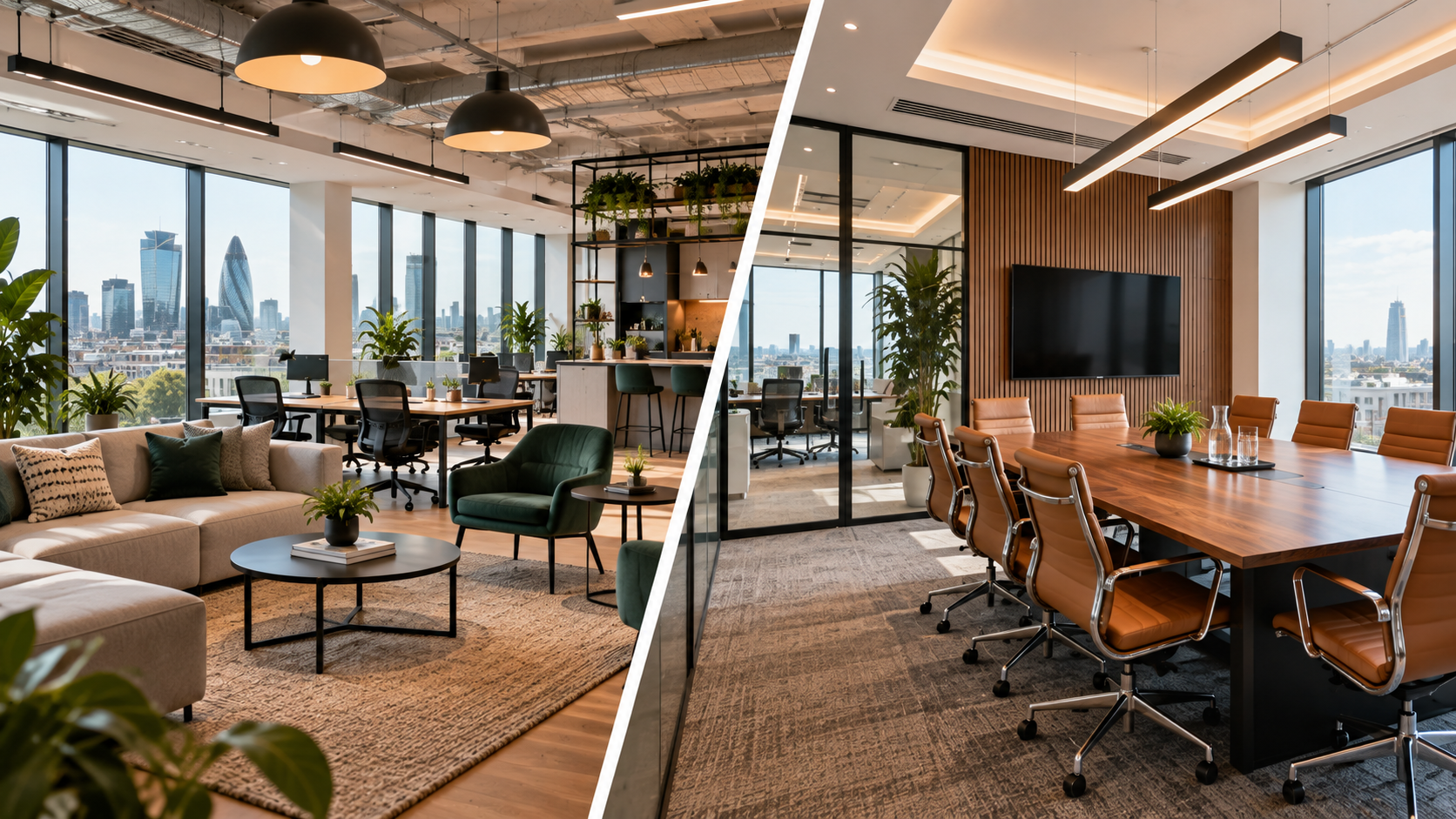
Serviced Offices vs Managed Offices: What's the Difference and Which Is Right for Your Business?
The way businesses occupy office space has changed significantly. Traditional long-term leases are no longer the only option for companies looking for a professional workplace. Today, businesses can choose from a wide range of flexible office solutions, including serviced offices and managed offices.
Both options offer alternatives to conventional office leasing, potentially reducing upfront expenditure, simplifying property management and providing greater flexibility. However, there are important differences between the two.
For businesses considering relocating, expanding or reviewing their current office requirements, understanding these differences can help identify the most suitable workspace solution.
In this guide, we explore what serviced offices and managed offices offer, how their costs and contracts compare, and what businesses should consider before making a decision.
What Is a Serviced Office?
A serviced office is a fully furnished, ready-to-use workspace operated and managed by a specialist office provider.
Businesses typically occupy their own private office within a larger building, sharing facilities such as reception areas, kitchens, meeting rooms and communal breakout spaces with other occupiers.
Serviced offices are generally available through flexible licence agreements, although contractual arrangements vary between providers.
One of their main attractions is convenience. Instead of arranging furniture, internet connectivity, utilities, cleaning and maintenance separately, businesses can often access these services through a single monthly payment.
What Is Typically Included in a Serviced Office?
Depending on the provider, a serviced office package may include:
Fully furnished private office accommodation
Business-grade internet connectivity
Electricity, heating and air conditioning
Cleaning and general maintenance
Reception and front-of-house services
Shared kitchens and breakout areas
Access to meeting rooms
Security and building access systems
Utilities and business rates
Because much of the infrastructure is already in place, businesses can often move into a serviced office relatively quickly.
Serviced offices are particularly attractive to startups, SMEs, project teams, regional offices and established companies seeking flexibility without taking responsibility for operating an entire workplace.
What Is a Managed Office?
A managed office is a workspace solution where an operator provides and manages office accommodation tailored to the requirements of a particular business.
Unlike a typical serviced office, where multiple businesses occupy separate suites within a shared centre, managed offices are often designed around the needs of one occupier.
A managed office might comprise a self-contained floor, an entire building or a dedicated office suite with its own meeting rooms, kitchen, breakout areas and facilities.
The operator may take responsibility for designing, fitting out, furnishing and managing the workspace, depending on the commercial agreement.
This enables businesses to enjoy many of the advantages of a traditional headquarters while avoiding some of the complexities associated with managing their own leased premises.
What Is Typically Included in a Managed Office?
Managed office packages can include:
A dedicated, self-contained office
Bespoke office design and layout
Furniture and workstation installation
Private meeting rooms and collaboration areas
Dedicated kitchen and breakout facilities
IT infrastructure and connectivity
Utilities and building services
Cleaning, maintenance and facilities management
Branding and signage opportunities
A tailored commercial agreement
The exact specification will depend on the size of the requirement, the property and the agreement with the operator.
Managed offices are often considered by established businesses seeking greater control over their workplace environment without managing the full property operation themselves.
Serviced Offices vs Managed Offices: The Key Differences
Although serviced and managed offices share many characteristics, their differences become clearer when comparing flexibility, personalisation, facilities and costs.
Feature | Serviced office | Managed office |
|---|---|---|
Workspace | Private suite in a shared centre | Often dedicated or self-contained |
Furniture | Usually included | Usually supplied to specification |
Fit-out | Typically already completed | Can be customised |
Branding | Often limited | Greater opportunities |
Meeting rooms | Often shared or bookable | Can be dedicated |
Contract length | Commonly shorter and flexible | Often longer to recover fit-out investment |
Monthly costs | Usually bundled | Often agreed as a tailored package |
Move-in time | Often relatively quick | May require design and fit-out |
Facilities management | Operator managed | Operator managed |
Neither arrangement is automatically cheaper or more flexible in every situation. The commercial terms and services offered can differ substantially between workspace providers.
1. Flexibility and Contract Length
Flexibility is one of the main reasons businesses consider alternatives to conventional office leases.
Serviced offices frequently offer shorter commitments than traditional leased accommodation. Some providers offer monthly agreements, while others require commitments of six, twelve or more months.
This can be useful for businesses experiencing rapid growth, operating temporary projects or entering new markets.
Managed offices generally involve a greater level of commitment, particularly where an operator is investing in a bespoke fit-out.
For example, a business requesting a fully customised office for 100 employees may need to agree to a longer term than a company taking an existing ten-person serviced office.
However, a managed office arrangement may still offer more operational simplicity and different commercial flexibility compared with a conventional lease.
2. Office Design and Branding
Another important consideration is how much control a business requires over its workplace.
Serviced offices are generally designed to accommodate a wide range of occupiers. Although furniture layouts and configurations may be adjustable, significant alterations are not always possible.
Managed offices can offer greater opportunities for customisation.
A business may be able to specify its preferred office layout, meeting room configuration, furniture, collaboration areas, kitchen facilities and branding.
For companies where workplace identity, confidentiality or operational requirements are particularly important, this level of personalisation can be attractive.
3. Comparing the Costs
One of the most common questions businesses ask is:
Are serviced offices cheaper than managed offices?
The answer depends on the size of the workspace, location, specification, contract duration and services included.
Serviced offices are commonly priced on a per-desk or per-workstation basis, with many operating expenses incorporated into the monthly fee.
Managed offices are more likely to involve a bespoke quotation based on the total space, fit-out requirements, services and agreed term.
For smaller teams, serviced offices can be particularly cost-effective because businesses share facilities and avoid substantial upfront expenditure.
For larger occupiers, a managed office may provide different economies of scale, particularly where dedicated meeting rooms, kitchens and other facilities are required.
The most useful comparison is the total cost of occupancy, not simply the advertised monthly rent or price per workstation.
Businesses should consider setup fees, deposits, internet provision, meeting room charges, business rates, utilities, maintenance, fit-out expenditure and potential exit costs.
4. Privacy and Exclusivity
Both serviced and managed offices can provide private, secure workspace.
However, the degree of exclusivity often differs.
In a serviced office building, businesses may share reception areas, corridors, kitchens, meeting facilities and communal spaces.
Managed offices can provide a more self-contained environment, potentially including dedicated entrances, meeting rooms and staff facilities.
For organisations dealing with confidential information, specialist technology or specific security requirements, this distinction may influence their decision.
Importantly, businesses should assess the actual physical and technical security arrangements rather than assuming one type of workspace is inherently more secure.
5. Why Managed Offices Are Attracting Corporate Occupiers
The managed office sector has developed as larger businesses seek a balance between flexibility and control.
Research from property consultancy JLL highlights how managed offices can accommodate businesses that have outgrown traditional serviced offices while retaining the advantages of outsourced workplace management.
In its report London Offices – The Rise of Managed Solutions, JLL reported that 75% of clients taking managed space through its London flexible workspace team over an 18-month period had previously occupied serviced offices. This is a historical finding from JLL's own client activity, rather than a measure of the entire market.
The development reflects an important distinction: businesses may want the independence and identity associated with a traditional headquarters without taking responsibility for the entire property operation.
Managed offices can offer that middle ground.
6. Which Office Solution Suits Different Businesses?
Startups and Small Businesses
For a small business seeking an immediate professional workspace, a serviced office can provide access to facilities without significant upfront expenditure.
Growing SMEs
Businesses experiencing changing headcount may value the ability to expand into additional offices within an existing serviced office centre. Once their requirements become more predictable, a managed office may also become attractive.
Established Corporate Occupiers
Larger organisations requiring dedicated meeting rooms, bespoke layouts, branded reception areas or more complex IT infrastructure may consider managed office solutions.
Project Teams and Regional Offices
For businesses establishing temporary project teams or entering new markets, either arrangement may be appropriate depending on the duration, size and complexity of the requirement.
7. Questions to Ask Before Choosing an Office
Before committing to either a serviced or managed office, businesses should establish their current and future requirements.
Consider how many employees will regularly attend the workplace, whether hybrid working will affect workstation demand, and how many meeting rooms are genuinely necessary.
It is also important to understand what is included in the advertised price, how the agreement deals with expansion or downsizing, and whether there are additional charges for services.
For managed offices, particular attention should be given to the fit-out specification, delivery programme, responsibility for alterations and arrangements at the end of the agreement.
The Future of Flexible Workspace
The distinction between conventional leases, managed offices and serviced offices is becoming increasingly important as businesses reconsider how they use commercial property.
JLL's April 2026 research, The Flexible Office Space Imperative, discusses how corporate occupiers can combine traditional and flexible accommodation within their wider property strategies. It also highlights the importance of matching workspace arrangements to operational needs and security requirements.
April 2026 jll.com The Flexible
Rather than choosing one model for every location, businesses can assess different workplace solutions for their headquarters, regional operations, project teams and growth plans.
This creates opportunities for both serviced and managed office providers to accommodate a wider range of occupiers.
Find Serviced and Managed Offices with Right Space
Whether you're searching for a fully furnished private office, a dedicated managed workspace or a flexible alternative to a conventional commercial lease, finding the right accommodation begins with understanding your requirements.
Right Space is a directory designed to help businesses discover and compare flexible workspace options, including serviced offices, managed offices, coworking memberships and meeting rooms.
Explore available workspace, discover different locations and find office accommodation that supports the way your business operates today and how it may grow in the future.
Start your search with Right Space and discover your next workspace.