
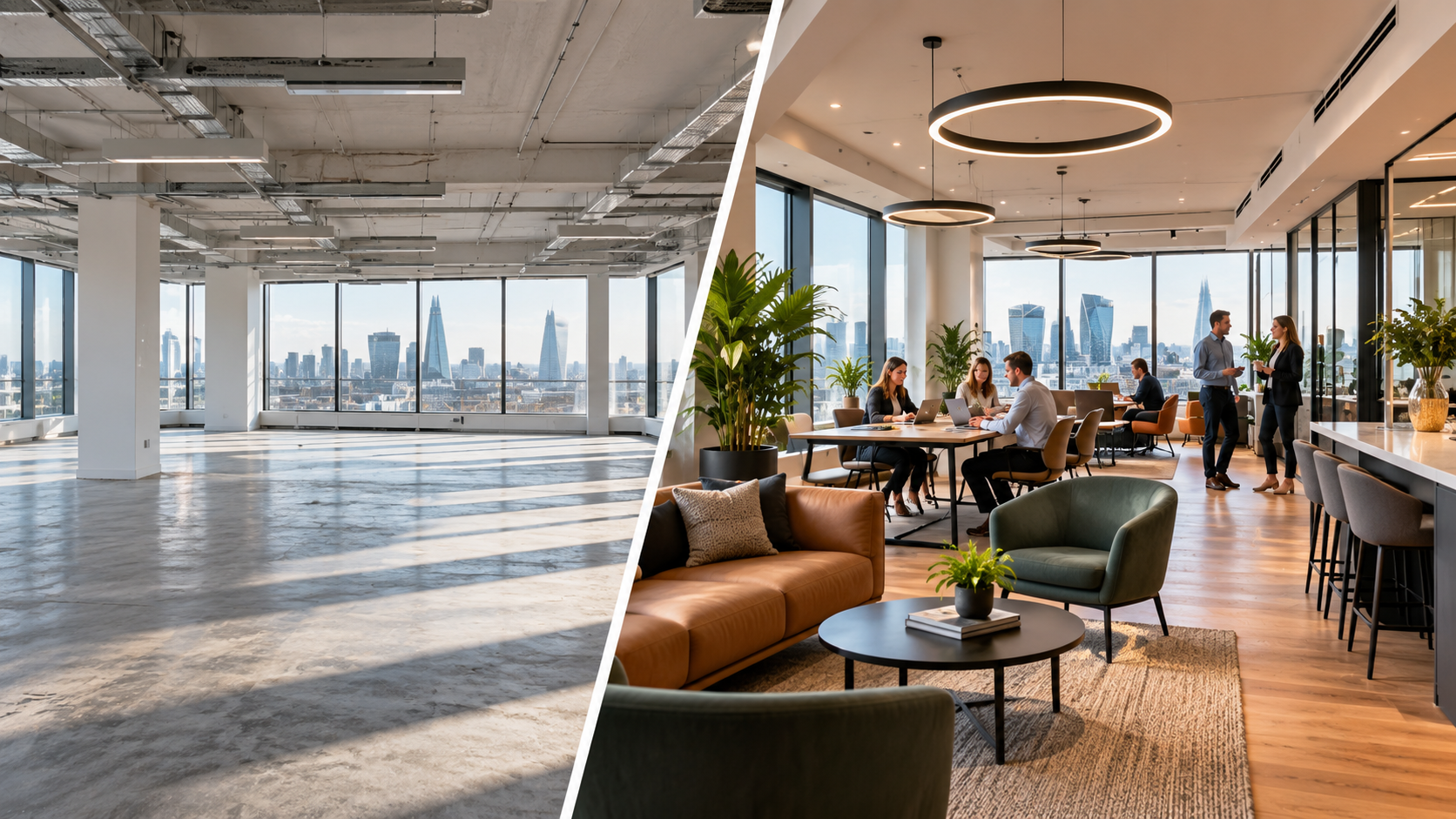
Why Corporate Occupiers Are Moving from Conventional Leases to Serviced Offices
For decades, the conventional office lease was the default choice for established businesses. A company would take a floor or an entire building, commit to a long-term lease, invest heavily in fitting it out and operate the space itself.
That model isn't disappearing, but it is no longer the only serious option for larger organisations.
Increasingly, corporate occupiers are considering serviced offices, managed offices and other forms of flexible workspace alongside conventional leased space.
What was once associated primarily with startups, freelancers and small businesses has developed into a much broader office market capable of accommodating established companies and larger teams.
So why are businesses reconsidering the traditional office lease?
1. Businesses Want Greater Flexibility
Perhaps the biggest difference between a conventional lease and serviced office is commitment.
Traditional commercial leases can require businesses to make decisions about their property requirements years into the future. But predicting how much office space a company will need has become increasingly difficult.
Headcount can change. Teams can expand or contract. Businesses can restructure, enter new markets or adopt different hybrid-working policies.
A serviced office can allow an occupier to commit for a shorter period and adjust its requirements more easily.
For a corporate occupier, that flexibility can have considerable value.
Rather than asking:
"How much office space will we need in five or ten years?"
the business can make decisions based much more closely on what it needs today.
2. Hybrid Working Has Changed Office Requirements
The relationship between headcount and office space has changed.
Historically, a business employing 200 office-based people might have planned its property requirement around providing approximately 200 permanent workstations.
Hybrid working can make that calculation considerably more complicated.
If employees divide their time between the office, home and other locations, businesses may no longer need a dedicated desk for every employee.
Instead, companies are increasingly focused on how the office is actually used.
Collaboration areas, meeting rooms, breakout spaces and shared workstations can become more important than rows of permanently allocated desks.
Flexible workspace can fit naturally into this model because businesses can purchase capacity based on their real occupancy requirements rather than simply their total employee count.
3. The True Cost of a Conventional Office Is Much More Than Rent
Comparing a serviced office with conventional office space purely on the headline rent can be misleading.
Taking a conventional lease can involve numerous additional costs, potentially including:
Office fit-out
Furniture
IT infrastructure
Internet connectivity
Utilities
Service charges
Business rates
Cleaning
Repairs and maintenance
Security and access control
Reception and front-of-house services
Meeting room technology
Kitchen facilities
Dilapidations and reinstatement costs
There is also the internal resource required to procure and manage those services.
Serviced offices typically combine many property and operational costs into a single monthly fee.
That doesn't automatically make a serviced office cheaper in every situation. However, it can make the total cost of occupancy more predictable and significantly reduce the operational burden placed on the occupier.
4. Fit-Out Costs Can Be Significant
One of the largest barriers to taking conventional office space is the upfront investment required.
An empty office may need everything from partitioning and meeting rooms to furniture, cabling, kitchens, AV equipment and branding before employees can move in.
For larger spaces, the capital requirement can be substantial.
A serviced or managed office transfers much of that responsibility to the workspace operator.
The occupier can therefore gain access to a fitted, furnished and operational workplace without necessarily committing significant capital to a property it doesn't own.
For companies prioritising investment into people, technology, acquisitions or growth, reducing property-related capital expenditure can be attractive.
5. Companies Can Move In Much Faster
Finding an office is only part of the conventional leasing process.
There can then be negotiations, legal work, design, planning, procurement and construction before the space is actually ready.
Serviced offices can dramatically reduce this mobilisation period.
Many spaces are already furnished, connected and operational. Depending on the requirements and availability, businesses can potentially begin occupying their new workplace much sooner.
This can be particularly valuable for a business that has secured a new contract, is rapidly expanding or needs to establish a regional office quickly.
6. Expansion Into New Markets Becomes Easier
Imagine a company headquartered in London wants to establish a team in Manchester.
Under the traditional model, it could search for an office, negotiate a lease and invest in fitting out the space before knowing exactly how large its Manchester operation will eventually become.
A serviced office provides another option.
The business could initially accommodate a relatively small team and increase its workspace requirement as the operation develops.
The same principle applies internationally.
Flexible workspace can provide businesses with a way to establish operations in new cities without immediately making a major long-term property commitment.
7. Corporate Occupiers Want Better Employee Experiences
Modern offices aren't simply places containing desks.
Businesses increasingly consider the workplace part of the overall employee experience.
High-quality serviced office buildings may provide amenities such as staffed reception areas, lounges, collaboration spaces, meeting rooms, showers, cycle storage, gyms, cafés and organised events.
For an individual occupier to reproduce the same range of amenities within its own demise could be expensive or impractical.
A flexible workspace allows those facilities to be shared between multiple businesses.
That can give relatively small corporate teams access to amenities normally associated with much larger headquarters buildings.
8. Serviced Offices Can Reduce Management Burden
Operating an office involves more work than many people realise.
Someone has to manage cleaners, internet providers, utilities, furniture, maintenance, contractors, meeting rooms and numerous other day-to-day requirements.
With a serviced office, much of this responsibility sits with the workspace operator.
Employees arrive and use the space while the operator manages the building and workplace environment.
For businesses without dedicated property or facilities teams—or companies that simply don't want to allocate resources to running an office—this can be a significant advantage.
9. Businesses Can Take Space Based on Actual Usage
One of the interesting consequences of hybrid working is that businesses can have considerably more employees than desks.
A company employing 100 people may discover that it rarely has anywhere near 100 employees in the office simultaneously.
Understanding actual occupancy can therefore fundamentally change a company's property requirement.
Instead of asking how many employees the company has, property teams can consider questions such as:
How many people are typically in the office each day?
What is our peak occupancy?
How many meeting rooms do we actually need?
How much space is currently sitting unused?
Flexible office arrangements can make it easier to align property costs with genuine workspace demand.
10. Serviced Offices Are No Longer Just for Small Businesses
Perhaps the biggest change is simply the quality and scale of the flexible office market itself.
The term "serviced office" once created an image of small individual offices occupied by startups and companies requiring temporary accommodation.
The market today is much broader.
Businesses can find private office suites, self-contained floors, managed offices, enterprise workspace and even bespoke headquarters-style solutions operated on flexible terms.
That has made the sector increasingly relevant to larger organisations.
A corporate occupier doesn't necessarily have to choose between a traditional lease and a small serviced office. There is now a substantial spectrum between the two.
Conventional Lease vs Serviced Office: Which Is Better?
There isn't a universal answer.
A conventional lease can still make considerable sense for organisations with predictable long-term requirements, particularly where they want complete control over the design, branding and operation of their workplace.
Serviced and managed offices become particularly interesting where flexibility, speed, reduced capital expenditure and simplicity are priorities.
The decision therefore needs to consider total occupancy cost, flexibility and operational requirements, rather than headline rent alone.
A serviced office might initially appear more expensive on a simple £ per sq ft comparison, while the calculation can look very different once fit-out, furniture, utilities, business rates, service charges, connectivity and management costs are included.
The Future May Be a Mixture of Both
The future of corporate real estate doesn't necessarily mean companies abandoning conventional leases altogether.
Instead, many organisations may operate a combination of different workspace models.
A business might retain a conventional headquarters while using serviced offices for regional teams, project groups, temporary requirements or expansion into new markets.
Others may decide that their entire office portfolio can operate more efficiently through flexible workspace.
The important change is that serviced offices have become a genuine corporate real-estate option rather than simply a temporary solution.
Find Serviced Offices with Right Space
As the flexible workspace market grows, businesses have more choice than ever.
Right Space helps companies discover serviced offices, private offices, coworking spaces, meeting rooms and other flexible workspace, making it easier to compare options and find space suited to their requirements.
Whether you're relocating an established business, opening a new regional office, accommodating a project team or reconsidering a conventional lease, exploring the flexible office market can reveal alternatives that may not have existed when your current property strategy was created.
Search Right Space to discover flexible office space for your business.